Showing posts with label Research and Planning. Show all posts
Showing posts with label Research and Planning. Show all posts
Thursday, 11 April 2013
Focus Group 1
The first focus group was on our poster ad, we mainly got good feedback and some understandable criticisms on the less likeable examples. We didn't tell our focus group who the posters belonged too because we thought that people might then judge them differently if they knew whose was who. The objective was to find out which one was they thought was the best, to work out which one would best fit our target audience.

Monday, 8 April 2013
Focus Group 2
For our second focus focuses more on the different elements and really depicts what they like about the ads and what could be changed to help target our audience. They understood where we were coming from and they could make the link between the message and the fact that is was so dark. They seemed to be extremely good at giving us tips and how they thought our colours and overall compositions brought the message forward. These focus groups have really helped us to chose the one we are going to put in the newspaper and which one we wanted the public to recognise our documentary to be about.
Friday, 8 March 2013
The changes on ad
After many different focus groups on what we could change and retain from the poster ads, we decided that we could see whether a few of these changes would make our ad look more appealing to our audience. We changed the font of the title, to see whether it made any difference to what our ad was trying to portray. Our group thought that our original font was better than the new on, so we decided to keep it.

Another change was to put the line from another draft we had in that font, this was because it allowed the audience to actually know what the documentary is about; 'Are We All Addicted'.... Changing the title made more sense to what we are trying to get across, the change in font is not necessary.


Another change was to put the line from another draft we had in that font, this was because it allowed the audience to actually know what the documentary is about; 'Are We All Addicted'.... Changing the title made more sense to what we are trying to get across, the change in font is not necessary.

Examples of Radio Ad
Here are few examples that I picked out from YouTube to illustrate the kind of sound and quality we are looking for.
This one is an advert on a radio station about a new documentary, using just a voice and a little music and sound effects.
This advert is clearly about Snickers, and for the people who have seen the actual advert on TV, many of them will understand what the radio ad is about just by the voice.
This one is an advert on a radio station about a new documentary, using just a voice and a little music and sound effects.
This advert is clearly about Snickers, and for the people who have seen the actual advert on TV, many of them will understand what the radio ad is about just by the voice.
Thursday, 7 March 2013
Radio Conventions
Our documentary needs more advertisement to improve our chances for more views; we are undertaking some radio conventions research to broaden our knowledge on the subject.
Average duration: 30 seconds to 3 minutes
Use of SFX: most use reverb, delay and compression to improve sound quality and overall effect they are trying to give
Use of extracts from the documentary: there is normally a lot of dialogue in the radio adverts to keep the listeners focused. The people that are talking would usually make sure that whatever is being advertised is done in detail and clear, because unlike seeing an ad the listeners can't picture it.
How music is used to target specific audience: Obviously on the radio there is a lot of music being played, sometimes constantly. To appeal to a specific audience they would have to put the ad on a radio station that is being listen to by their target audience. Radio stations would use POP for example, to entice a younger audience for a documentary about something that they know they would be interested in.
How language is used to target specific audience: On radio stations that language is practically conversational and informal, to interact with their audience rather than talk to them.
How VoiceOver is used: If a radio station is advertising the trailer to a movie, then a voiceover is usually used to illustrate what the music and special effects are about.
Average duration: 30 seconds to 3 minutes
Use of SFX: most use reverb, delay and compression to improve sound quality and overall effect they are trying to give
Use of extracts from the documentary: there is normally a lot of dialogue in the radio adverts to keep the listeners focused. The people that are talking would usually make sure that whatever is being advertised is done in detail and clear, because unlike seeing an ad the listeners can't picture it.
How music is used to target specific audience: Obviously on the radio there is a lot of music being played, sometimes constantly. To appeal to a specific audience they would have to put the ad on a radio station that is being listen to by their target audience. Radio stations would use POP for example, to entice a younger audience for a documentary about something that they know they would be interested in.
How language is used to target specific audience: On radio stations that language is practically conversational and informal, to interact with their audience rather than talk to them.
How VoiceOver is used: If a radio station is advertising the trailer to a movie, then a voiceover is usually used to illustrate what the music and special effects are about.
Wednesday, 6 March 2013
Tuesday, 5 March 2013
Our ads
These are the images that my group and I have created using Photoshop, with the image we took before hand. We used different fonts, colours and layout; to make sure that we appeal to all of our audiences, so we undertook a number of focus groups to get their responses so that we can improve them.


Friday, 1 March 2013
Tuesday, 26 February 2013
Poster analysis: Uses and Gratification theory
Today we looked at different poster ads from Channel4 and analysed them, using the user and gratification theory. Relating it to the audience and how it effects them; font, image, colour, layout, language etc.
I chose this ad for Channel4- Disarming Britain because it was striking, using children to express the dangerous acts that happen in Britain now a days. The simplicity of it relates to some of things my group and I have been talking about when it comes the advertisment of our documentary. The amount of people in the shot was something we were discusssing, one or two? I thought one we be a good idea compared to two, this is because it reflects what we are trying to get across. Technology practically taking over us and its in everyone, although putting billions of people in one shot may confuse the audience. However, this does then relate to our audience: the reformers, who want a challenge to wonder why we put so many people in the shot.

Wednesday, 13 February 2013
Call sheet- Advertisment
Picture Practice
THURSDAY 14TH FEBURARY 2013
Who- Victoria, Ali, Dakota
When- 14th Feb
Where-Auditorium
Time- 8:50-9:50
Who- Victoria, Ali, Dakota
When- 14th Feb
Where- Auditorium
Time- 1:10-2:10
Props Needed:
Pills
Clothing (Navy bue/Black)
Syringe (Science)
Mobile Phone
Tablet
Child
Lights
Cast:
Ishmael
THURSDAY 14TH FEBURARY 2013
Who- Victoria, Ali, Dakota
When- 14th Feb
Where-Auditorium
Time- 8:50-9:50
Who- Victoria, Ali, Dakota
When- 14th Feb
Where- Auditorium
Time- 1:10-2:10
Props Needed:
Pills
Clothing (Navy bue/Black)
Syringe (Science)
Mobile Phone
Tablet
Child
Lights
Cast:
Ishmael
Tuesday, 12 February 2013
Monday, 11 February 2013
The 12 types of advertising
- The demo
- The problem
- Symbolise the probem
- Symbolise the benefit
- Comparison
- Exemplary story
- Benefit causes story
- Testimoial
- Ongoing character or celebrity
- Associated user imagery
- Unique personality property
- Parody or borrowed format
To advertise for our documentary we have decided to use symbolising the problem as our type of advertising. This reflects the way we want our audience to feel and what they are hoping to feel when they see it. They like to be enlightened and challenged by what they see and hopefully our ad can do that by how much we give away, what questions we ask and how it is presented.
For example we liked the look of the 'end of the world concept, like the cover/poster of the 2012 film:

Friday, 8 February 2013
The Brief
Creative Brief
What are we promoting?
Documentary about being addicted to technology
Who are we talking to and what do we know about them?
We are talking about the Explorer's and Reformer's of the world, we know that they like to be challenged and to find something that they have never seen before.
How do we want them to feel after reading our ad?
Enlightened and challenged
What is the single most important message we want to communicate?
THAT WE ARE ALL ADDICTED!
What tone of voice should we use?
Assertive
Demanding
P.A.S.C.O.E CHECKLIST
Purpose:
To inform and challenge our audience
Audience:
Individuals that take pleasure in learning new things
Style:
Dark
QuestioningContent:
Perhaps images of photos of all type of people walking towards a light to emphasis the 'we are all addicted' concept??
Organisation:
Effect:
Should allow our audience to feel like they are being challenge after they see the ad and to be enlightened once they have found out what it is about.
Monday, 4 February 2013
Friday, 1 February 2013
Young & Rubicam
First Young & Rubicam various ideas to put a more spin on Maslow's Hierarchy by chosing the core desires at each stage in the hierarchy: Enlightenment, Discovery, Control, Status, Security, Escape and Survival.
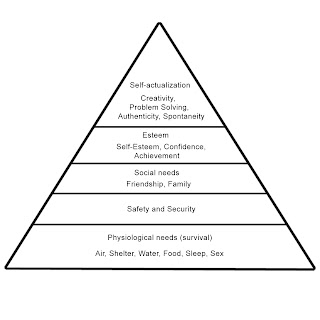 Splitting the stages up into 7 different groups that explore 7 types of people; everyone is one of these or if not a mixture of 2.
Y & R say:
The Explorer
These people are driven by a need for discovery, challenge and new frontiers. Young in nature, if not in reality, Explorersare often the first to try new ideas and experiences. They respond to brands that offer new sensations, indulgence and instant effects. In short, difference is what they seek out.
Their core need in life is for DISCOVERY.
The Aspirer
Materialistic, acquisitive peope, who are driven by others' perceptions of them rather than bytheir own values. As a result, they respond to what others perceive as being superficial: image, apperancce, persona, charisma and fashion. An attractive pack is as important to them as its contents. Their core need in life is for STATUS.
The Succeeder
Succeeders, possess self-confidence, have a strong goa orientation and tend to be very organised. As a result, theytend to occupy positionsof responsiblity in society. Their investment in the status quo means they tend to support it.Whenit come to brands, theyseek reward and prestig, and will often seek out the best because that is what they feel they deserve. On the other hand, they aso seek out caring and protective brands- their aggressive attitude to life means they need to relax occasionally. Their core need in life is for CONTROL.
The Reformer
"Don't tell me what to do or what to think" says the reformer, valuing their own independent judgement. Reformers aren the most anti-materialistic of the seven groups, and are often perceived as intellectual.They are socially aware, and pride themselves on tolerance.Reformers seek out the authentic and the harmonious, and are often at the leading edge of society. However, unlike Exporers, they will not buy things just because they are new. Their core need in life is ENLIGHTENMENT.
The Mainstream
These are people who live in the world of the domestic and everyday. A daily routine is fundamenta to the way they live their lives. Their life choices are 'we' rather than 'me'. As their name implies, they are the mainstream of society. They are the largest group of people within 4Cs across the world.They respond to bug established brands, to 'family brands and to offers of value for money. Their core need in life is for SECURITY.
The Struggler
Strugglers live for today, and make few plans for tomorrow. Others often see them as victims, loseres and wasters-aimess, disorganised people within few resources apart from their own physical skills. If they get on in life, it will depend more on a winning lottery ticket than anything they do themselves. They are heavy consumers of alcohol and junk food. Visual impact and physical sensation are an important element of their brand choices. In essence, theyseek ESCAPE.
The Resigned
These are predominantly older people constant, unchanging values built up over time. For respect institutions and enjoy acting traditional roles. Their brand choices are driven by a need for safety and for econom. They choose above all what is familiar to them. In life, their ain is basic, it is to SURVIVE.
Y & R say:
The Explorer
These people are driven by a need for discovery, challenge and new frontiers. Young in nature, if not in reality, Explorersare often the first to try new ideas and experiences. They respond to brands that offer new sensations, indulgence and instant effects. In short, difference is what they seek out.
Their core need in life is for DISCOVERY.
The Aspirer
Materialistic, acquisitive peope, who are driven by others' perceptions of them rather than bytheir own values. As a result, they respond to what others perceive as being superficial: image, apperancce, persona, charisma and fashion. An attractive pack is as important to them as its contents. Their core need in life is for STATUS.
The Succeeder
Succeeders, possess self-confidence, have a strong goa orientation and tend to be very organised. As a result, theytend to occupy positionsof responsiblity in society. Their investment in the status quo means they tend to support it.Whenit come to brands, theyseek reward and prestig, and will often seek out the best because that is what they feel they deserve. On the other hand, they aso seek out caring and protective brands- their aggressive attitude to life means they need to relax occasionally. Their core need in life is for CONTROL.
The Reformer
"Don't tell me what to do or what to think" says the reformer, valuing their own independent judgement. Reformers aren the most anti-materialistic of the seven groups, and are often perceived as intellectual.They are socially aware, and pride themselves on tolerance.Reformers seek out the authentic and the harmonious, and are often at the leading edge of society. However, unlike Exporers, they will not buy things just because they are new. Their core need in life is ENLIGHTENMENT.
The Mainstream
These are people who live in the world of the domestic and everyday. A daily routine is fundamenta to the way they live their lives. Their life choices are 'we' rather than 'me'. As their name implies, they are the mainstream of society. They are the largest group of people within 4Cs across the world.They respond to bug established brands, to 'family brands and to offers of value for money. Their core need in life is for SECURITY.
The Struggler
Strugglers live for today, and make few plans for tomorrow. Others often see them as victims, loseres and wasters-aimess, disorganised people within few resources apart from their own physical skills. If they get on in life, it will depend more on a winning lottery ticket than anything they do themselves. They are heavy consumers of alcohol and junk food. Visual impact and physical sensation are an important element of their brand choices. In essence, theyseek ESCAPE.
The Resigned
These are predominantly older people constant, unchanging values built up over time. For respect institutions and enjoy acting traditional roles. Their brand choices are driven by a need for safety and for econom. They choose above all what is familiar to them. In life, their ain is basic, it is to SURVIVE.
Tuesday, 29 January 2013
Advertising
Who is the target audience of both forms?
This ad appeals to a wide range of audiences because the Wii is supposed to be for everyone, the younger audience would be attracted to this because it shows all the different games that is being advertised. They also use iconic celebrities to introduce them to what they are selling, using this technique will not only appeal to the male generation (the football community) but the female generation, because of the seemingly heart throb (Jamie Redknapp). Also to the older generation because Harry Redknapp is used to represent these people, meaning that anyone can use this type of device.

What devices/ techniques, and technical and symbolic codes have been used to engage audience?
Analyse Genre and Narrative
- Remember that although the products you choose will be the same there may be a primary and secondary audience depending on the format – billboards for example have mass target audience (depending on positioning) while print adverts will be specifically targeting the reader of the magazine / newspaper…
- What is the Audience Appeal of both forms – how are audiences targeted? Audio visual adverts tend to have higher production values which are one appeal but think of as many ways as you can that the advert communicates with its audience. The sample Adidas television advert has an upbeat mode of address for example.
This ad appeals to a wide range of audiences because the Wii is supposed to be for everyone, the younger audience would be attracted to this because it shows all the different games that is being advertised. They also use iconic celebrities to introduce them to what they are selling, using this technique will not only appeal to the male generation (the football community) but the female generation, because of the seemingly heart throb (Jamie Redknapp). Also to the older generation because Harry Redknapp is used to represent these people, meaning that anyone can use this type of device.
This ad suggests that it would appeal to teenagers for the obvious reason, that it shows younger people using it, it could also appeal more to girls, because the ad uses the band JLS to perhaps get more viewings, which it probably does.
What devices/ techniques, and technical and symbolic codes have been used to engage audience?
- How do these techniques conventions differ in both audio-visual, online print format depending on the platform you choose?
- If audio-visual think about types of shot and framing, diegetic and non diegetic sound, editing, camerawork, CGI (if relevant) and all the elements of the mise-en-scene.
- If online think about if the advert is above the fold or below the fold, what type of advert it is – Pop Up, Banner, Skycraper, Button, Overlayz, Flash? Is it ‘grouped’ or ‘nested’ with other adverts or articles, is it near or in the Leader-board or near the Hero Shot?
- If a print advert think about juxtaposition, prominence and positioning, choice of subject, framing and type of shot again, colour palette, textual signifiers and lighting.
This ad helps the audience to know about the product and what kind of things it does. The subjects in the ad are there to help the audience get to a conclusion of what the device does. The way that it is set out helps the audience understand what kind of scene this product can be played in, playing it in, probably the most comfortable place in the house, would appeal to most people. There seems to always be more than one person in the shot at one time, in each of these product ads, suggesting that this type of product can be played together, bring people closer together perhaps?
Analyse Genre and Narrative
- Advertising does always lend itself to a straightforward study of narrative but if it does what genre codes and conventions are apparent and why are they being used?
- In terms of narrative think about how a story is being constructed – more obvious with audio-visual advertising but just as apparent in other formats once broken down.
- Remember narrative structure – is there an obvious 3 act structure (beginning, middle and end), is it linear, single stranded and does it deliberately use narrative enigmas to tease the audience?
Tuesday, 22 January 2013
One way to show statistics
We next looked at a way of showing some of the statistics that we have, on addiction. We decided to take inspiration from the TV program 'Embarrassing Bodies' where they show the audience their statistics on what type of diseases that are most common in women for example. It is just a better way of looking at it, than a black screen with writing on it. Looking at a coloured screen with faded images in the background that relate to what they are talking about, is a lot better.
Something like this could be used in our editing because our documentary is quite bright and visual, so a black screen might take away that meaning. Something vibrant in the background of the statistics would keep our audience focused on the screen and they would probably be likely to actually read them.
I have found some examples of statistics that agree with what one of our interviewee's have said:
Something like this could be used in our editing because our documentary is quite bright and visual, so a black screen might take away that meaning. Something vibrant in the background of the statistics would keep our audience focused on the screen and they would probably be likely to actually read them.
I have found some examples of statistics that agree with what one of our interviewee's have said:
- 1 in 3 users would rather go a week without sex than give up their device- NBCNEWS.com
- 21% would rather starve than go without their mobile phones 'Daily Mail'
Answering our questions
I looked at this link to understand different ways of answering the questions that we have throughout our documentary. This link showed that with each transition the speaker has created a question or statement that he later illustrates with either his voice answering it, images or a specialist talks about it.
This ties in with our documentary because when we have interviews with the specialists before they answer our questions we need some way of asking them. For our first interview we have done that by having clear cut aways that have a voice over it, asking the question. After that in comes our interviewee with an answer. However, with our second interviewee he doesn't seem to answer the question properly, so we are going to have to use black screens or a voice over, to allow us to ask him a question that his interview relates to.
Wednesday, 16 January 2013
Schedule for the weekend
Since there has been lots of exams going on, it has been very difficult to get everyone working on documentary at the same time. Ali has been doing exams for the past two weeks, which has meant that me and Dakota have had to make some changes. We have begun to add in some cut aways to keep flow in the interviews and some establishing shots of place that are going to be important in the doc. establishing shots will be important to establish where the specialist and characters are based.
What we hope to achieve by the end of the week:
15th Jan
Filming
Who: Victoria
Where: Her house
Shots:
- Shots outside Victoria's house
- Cutaway shots on the comp, phone, watching tv etc..
- Observation shots of pedestrians on the street, bus etc
16th Jan
*Meet at 10:50 Room 004 for camera exchange*
Who: Dakota
Where: 004
-Upload footage
-Research new title fonts
-How will we show questions?
-Record quick voice over so we know what we expect
- Write a new voice over.
17th Jan
Who: Dakota
Where: 004
(all of the above from 16th Jan if not finished)
18th - 19th Jan
Who: Dakota
Where: Anywhere
-Film more establishing shots
- more cutaways
What we hope to achieve by the end of the week:
15th Jan
Filming
Who: Victoria
Where: Her house
Shots:
- Shots outside Victoria's house
- Cutaway shots on the comp, phone, watching tv etc..
- Observation shots of pedestrians on the street, bus etc
16th Jan
*Meet at 10:50 Room 004 for camera exchange*
Who: Dakota
Where: 004
-Upload footage
-Research new title fonts
-How will we show questions?
-Record quick voice over so we know what we expect
- Write a new voice over.
17th Jan
Who: Dakota
Where: 004
(all of the above from 16th Jan if not finished)
18th - 19th Jan
Who: Dakota
Where: Anywhere
-Film more establishing shots
- more cutaways
Monday, 14 January 2013
Quick re-post
The understanding of the demographic or audience profile for our documentary, which will allow us to advertise to our audience efficently. Who might consume our product:
- Age- Primary audience: 16-24, Secondary audience: 25-35
- Sex- Mix gender
- Income level- mosty part time jobs/ still in full time education for our primary audience. Full time jobs or unemployed
- Education- Yes
- Tastes in music- Has a broad range of genres
- Class- Mixture of classes
Subscribe to:
Posts (Atom)