Monday, 18 February 2013

Wednesday, 13 February 2013
Call sheet- Advertisment
Picture Practice
THURSDAY 14TH FEBURARY 2013
Who- Victoria, Ali, Dakota
When- 14th Feb
Where-Auditorium
Time- 8:50-9:50
Who- Victoria, Ali, Dakota
When- 14th Feb
Where- Auditorium
Time- 1:10-2:10
Props Needed:
Pills
Clothing (Navy bue/Black)
Syringe (Science)
Mobile Phone
Tablet
Child
Lights
Cast:
Ishmael
THURSDAY 14TH FEBURARY 2013
Who- Victoria, Ali, Dakota
When- 14th Feb
Where-Auditorium
Time- 8:50-9:50
Who- Victoria, Ali, Dakota
When- 14th Feb
Where- Auditorium
Time- 1:10-2:10
Props Needed:
Pills
Clothing (Navy bue/Black)
Syringe (Science)
Mobile Phone
Tablet
Child
Lights
Cast:
Ishmael
Tuesday, 12 February 2013
Monday, 11 February 2013
The 12 types of advertising
- The demo
- The problem
- Symbolise the probem
- Symbolise the benefit
- Comparison
- Exemplary story
- Benefit causes story
- Testimoial
- Ongoing character or celebrity
- Associated user imagery
- Unique personality property
- Parody or borrowed format
To advertise for our documentary we have decided to use symbolising the problem as our type of advertising. This reflects the way we want our audience to feel and what they are hoping to feel when they see it. They like to be enlightened and challenged by what they see and hopefully our ad can do that by how much we give away, what questions we ask and how it is presented.
For example we liked the look of the 'end of the world concept, like the cover/poster of the 2012 film:

Friday, 8 February 2013
The Brief
Creative Brief
What are we promoting?
Documentary about being addicted to technology
Who are we talking to and what do we know about them?
We are talking about the Explorer's and Reformer's of the world, we know that they like to be challenged and to find something that they have never seen before.
How do we want them to feel after reading our ad?
Enlightened and challenged
What is the single most important message we want to communicate?
THAT WE ARE ALL ADDICTED!
What tone of voice should we use?
Assertive
Demanding
P.A.S.C.O.E CHECKLIST
Purpose:
To inform and challenge our audience
Audience:
Individuals that take pleasure in learning new things
Style:
Dark
QuestioningContent:
Perhaps images of photos of all type of people walking towards a light to emphasis the 'we are all addicted' concept??
Organisation:
Effect:
Should allow our audience to feel like they are being challenge after they see the ad and to be enlightened once they have found out what it is about.
Monday, 4 February 2013
Friday, 1 February 2013
Young & Rubicam
First Young & Rubicam various ideas to put a more spin on Maslow's Hierarchy by chosing the core desires at each stage in the hierarchy: Enlightenment, Discovery, Control, Status, Security, Escape and Survival.
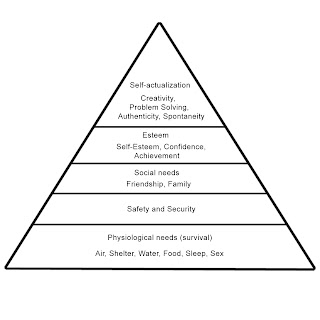 Splitting the stages up into 7 different groups that explore 7 types of people; everyone is one of these or if not a mixture of 2.
Y & R say:
The Explorer
These people are driven by a need for discovery, challenge and new frontiers. Young in nature, if not in reality, Explorersare often the first to try new ideas and experiences. They respond to brands that offer new sensations, indulgence and instant effects. In short, difference is what they seek out.
Their core need in life is for DISCOVERY.
The Aspirer
Materialistic, acquisitive peope, who are driven by others' perceptions of them rather than bytheir own values. As a result, they respond to what others perceive as being superficial: image, apperancce, persona, charisma and fashion. An attractive pack is as important to them as its contents. Their core need in life is for STATUS.
The Succeeder
Succeeders, possess self-confidence, have a strong goa orientation and tend to be very organised. As a result, theytend to occupy positionsof responsiblity in society. Their investment in the status quo means they tend to support it.Whenit come to brands, theyseek reward and prestig, and will often seek out the best because that is what they feel they deserve. On the other hand, they aso seek out caring and protective brands- their aggressive attitude to life means they need to relax occasionally. Their core need in life is for CONTROL.
The Reformer
"Don't tell me what to do or what to think" says the reformer, valuing their own independent judgement. Reformers aren the most anti-materialistic of the seven groups, and are often perceived as intellectual.They are socially aware, and pride themselves on tolerance.Reformers seek out the authentic and the harmonious, and are often at the leading edge of society. However, unlike Exporers, they will not buy things just because they are new. Their core need in life is ENLIGHTENMENT.
The Mainstream
These are people who live in the world of the domestic and everyday. A daily routine is fundamenta to the way they live their lives. Their life choices are 'we' rather than 'me'. As their name implies, they are the mainstream of society. They are the largest group of people within 4Cs across the world.They respond to bug established brands, to 'family brands and to offers of value for money. Their core need in life is for SECURITY.
The Struggler
Strugglers live for today, and make few plans for tomorrow. Others often see them as victims, loseres and wasters-aimess, disorganised people within few resources apart from their own physical skills. If they get on in life, it will depend more on a winning lottery ticket than anything they do themselves. They are heavy consumers of alcohol and junk food. Visual impact and physical sensation are an important element of their brand choices. In essence, theyseek ESCAPE.
The Resigned
These are predominantly older people constant, unchanging values built up over time. For respect institutions and enjoy acting traditional roles. Their brand choices are driven by a need for safety and for econom. They choose above all what is familiar to them. In life, their ain is basic, it is to SURVIVE.
Y & R say:
The Explorer
These people are driven by a need for discovery, challenge and new frontiers. Young in nature, if not in reality, Explorersare often the first to try new ideas and experiences. They respond to brands that offer new sensations, indulgence and instant effects. In short, difference is what they seek out.
Their core need in life is for DISCOVERY.
The Aspirer
Materialistic, acquisitive peope, who are driven by others' perceptions of them rather than bytheir own values. As a result, they respond to what others perceive as being superficial: image, apperancce, persona, charisma and fashion. An attractive pack is as important to them as its contents. Their core need in life is for STATUS.
The Succeeder
Succeeders, possess self-confidence, have a strong goa orientation and tend to be very organised. As a result, theytend to occupy positionsof responsiblity in society. Their investment in the status quo means they tend to support it.Whenit come to brands, theyseek reward and prestig, and will often seek out the best because that is what they feel they deserve. On the other hand, they aso seek out caring and protective brands- their aggressive attitude to life means they need to relax occasionally. Their core need in life is for CONTROL.
The Reformer
"Don't tell me what to do or what to think" says the reformer, valuing their own independent judgement. Reformers aren the most anti-materialistic of the seven groups, and are often perceived as intellectual.They are socially aware, and pride themselves on tolerance.Reformers seek out the authentic and the harmonious, and are often at the leading edge of society. However, unlike Exporers, they will not buy things just because they are new. Their core need in life is ENLIGHTENMENT.
The Mainstream
These are people who live in the world of the domestic and everyday. A daily routine is fundamenta to the way they live their lives. Their life choices are 'we' rather than 'me'. As their name implies, they are the mainstream of society. They are the largest group of people within 4Cs across the world.They respond to bug established brands, to 'family brands and to offers of value for money. Their core need in life is for SECURITY.
The Struggler
Strugglers live for today, and make few plans for tomorrow. Others often see them as victims, loseres and wasters-aimess, disorganised people within few resources apart from their own physical skills. If they get on in life, it will depend more on a winning lottery ticket than anything they do themselves. They are heavy consumers of alcohol and junk food. Visual impact and physical sensation are an important element of their brand choices. In essence, theyseek ESCAPE.
The Resigned
These are predominantly older people constant, unchanging values built up over time. For respect institutions and enjoy acting traditional roles. Their brand choices are driven by a need for safety and for econom. They choose above all what is familiar to them. In life, their ain is basic, it is to SURVIVE.
Subscribe to:
Posts (Atom)